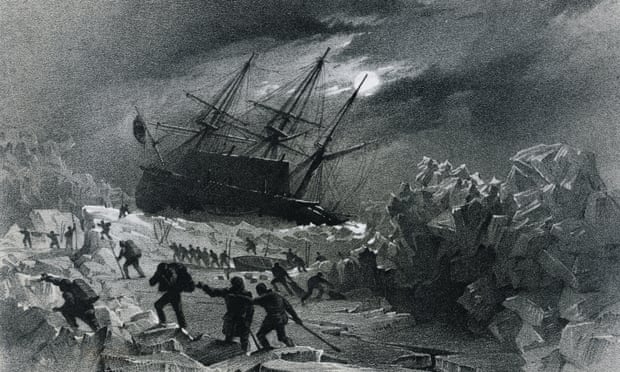
In 1845, Sir John Franklin departed England on the HMS Terror and HMS Erebus in search of the fabled Northwest Passage. None of the 129 men were ever seen again. While relics, debris and bones have been found, and now even the ships themselves, the full story of the Franklin Expedition only seems to get more mysterious. This site is a catalog of readings, speculations, and links to Franklin related materials, as the mystery continues to capitivate many to this day. His ghost haunts us still.
HMS Erebus, found September 2014
Franklin's Ghost
Arctic exploration and the search for the Northwest Passage has in many ways defined an essential part of the Canadian identity. The search for the lost Franklin Expedition in particular plays a significant role in defining Canada, both from mapping the mysterious frozen lands to interactions between Europeans and the ancient native cultures of the North to the symbolic and even mythic importance of the North to Canadian sovereignty and identity. As the ships and more evidence are discovered, interest in finding the elusive answers grows over 150 years after the expedition first set out, Sir John Franklin's ghost haunts us still.
This site is a catalog of the readings, thoughts and speculations of one amateur Canadian historian, as well as links to related materials and websites as the mystery continues to capitivate many to this day.
Ted Betts practices corporate law at a major Canadian law firm in Toronto. He obtained his BA and Master's in History from Queen's University in Kingston, Ontario with a focus on Canadian history (thesis: The Argument of the Century: The Ontario Press Coverage of the Scopes Trial and the Death of William Jennings Bryan). While he practices law and raises a family, he has remained a steadfast reader of history, particularly Canadian political and cultural history. Arctic exploration and the Franklin Expedition has over the years grown from an interest to a passion and now borders on being an obsession.
From Jeva Lange at The Week: Mysterious Inuit tale leads researchers to the 168-year-old wreck of the HMS Terror
In 1848, the ill-fated and ominously-named HMS Terrorwas lost along with the HMS Erebus in the worst polar disaster to ever hit the British Royal Navy: all 129 men in Sir John Franklin's Northwest Passage expedition were killed. For 11 years after the doomed trip, search parties continued to look for the Franklin expedition to no avail; the Inuit people now say bad spirits wander the island near where the ship went under.
But at long last, the arctic strait has given up its secrets, The Guardian reports. The HMS Terror has been discovered practically perfectly intact near King William Island, although it was found much farther south than it was thought to have been abandoned. "This discovery changes history," Canadian philanthropist and Arctic Research Founder Jim Balsillie told The Guardian. "Given the location of the find [in Terror Bay] and the state of the wreck, it's almost certain that HMS Terror was operationally closed down by the remaining crew who then re-boarded HMS Erebus and sailed south where they met their ultimate tragic fate."
The Terror almost wasn't discovered. An Inuk crewman on the team's research ship, Sammy Kogvik, 49, was talking with the Arctic Research Foundation's operations director, Adrian Schimnowski, when he recalled a hunting trip in Terror Bay, where he posed for a picture with a large piece of wood sticking out of the sea ice, which resembled a mast. When Kogvik got home and discovered his camera gone, he decided not to speak of the experience, believing the missing camera was an omen of the bad spirits that wander the island.
But by following Kogvik's tip, the researchers focused on the north end of Victoria Strait, eventually making their fateful discovery.
"This vessel looks like it was buttoned down tight for winter and it sank," said Schimnowski. "Everything was shut. Even the windows are still intact. If you could lift this boat out of the water, and pump the water out, it would probably float." Read more about the strange and incredible discovery of the HMS Terror at The Guardian. Jeva Lange
One thing seems now clear: Both ships were not simply abandoned, followed by a long death march along the western coast of KWI, but they both seem to have been remanned. This was certainly what you would conclude from Inuit oral testimony as re-told by David Woodman.
Unbelievably, the ship was found very close to shore, in sight of land and, ironically, in Terror Bay.
According to a comment from David Woodman, the ship was found near a known large shore encampment. Again, something supported by Inuit testimony. As would be the fact that it is in pristine condition consistent with a quick sinking.
Ship found in Arctic 168 years after doomed Northwest Passage attempt Exclusive: Perfectly preserved HMS Terror vessel sank during disastrous expedition led by British explorer Sir John Franklin
The long-lost ship of British polar explorer Sir John Franklin, HMS Terror, has been found in pristine condition at the bottom of an Arctic bay, researchers have said, in a discovery that challenges the accepted history behind one of polar exploration’s deepest mysteries.
HMS Terror and Franklin’s flagship, HMS Erebus, were abandoned in heavy sea ice far to the north of the eventual wreck site in 1848, during the Royal Navyexplorer’s doomed attempt to complete the Northwest Passage.
All 129 men on the Franklin expedition died, in the worst disaster to hit Britain’s Royal Navy in its long history of polar exploration. Search parties continued to look for the ships for 11 years after they disappeared, but found no trace, and the fate of the missing men remained an enigma that tantalised generations of historians, archaeologists and adventurers.
Now that mystery seems to have been solved by a combination of intrepid exploration – and an improbable tip from an Inuk crewmember.
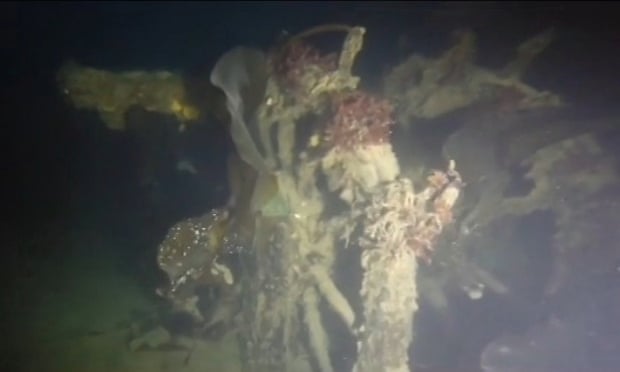
On Sunday, a team from the charitable Arctic Research Foundation manoeuvred a small, remotely operated vehicle through an open hatch and into the ship to capture stunning images that give insight into life aboard the vessel close to 170 years ago.
“We have successfully entered the mess hall, worked our way into a few cabins and found the food storage room with plates and one can on the shelves,” Adrian Schimnowski, the foundation’s operations director, told the Guardian by email from the research vessel Martin Bergmann.
“We spotted two wine bottles, tables and empty shelving. Found a desk with open drawers with something in the back corner of the drawer.”
The well-preserved wreck matches the Terror in several key aspects, but it lies 60 miles (96km) south of where experts have long believed the ship was crushed by ice, and the discovery may force historians to rewrite a chapter in the history of exploration.
The 10-member Bergmann crew found the massive shipwreck, with her three masts broken but still standing, almost all hatches closed and everything stowed, in the middle of King William Island’s uncharted Terror Bay on 3 September.
The bell of the HMS Terror. The bloody bell!
After finding nothing in an early morning search, the research vessel was leaving the bay when a grainy digital silhouette emerged from the depths on the sounder display on the bridge of the Bergmann.
“Everyone was up in the wheelhouse by that point in awe, really,” said Daniel McIsaac, 23, who was at the helm when the research vessel steamed straight over the sunken wreck.
Since, then, the discovery team has spent more than a week quietly gathering images of the vessel and comparing them with the Terror’s 19th century builders’ plans, which match key elements of the sunken vessel.
At first, the Terror seemed to be listing at about 45 degrees to starboard on the seabed. But on the third dive with a remotely operated vehicle, “we noticed the wreck is sitting level on the sea bed floor not at a list - which means the boat sank gently to the bottom,” Schimnowski said Monday.
About 24 metres (80ft) down, the wreck is in perfect condition, with metal sheeting that reinforced the hull against sea ice clearly visible amid swaying kelp.
A long, heavy rope line running through a hole in the ship’s deck suggests an anchor line may have been deployed before the Terror went down.
If true, that sets up the tantalising possibility that British sailors re-manned the vessel after she was abandoned at the top of Victoria Strait in a desperate attempt to escape south.
One crucial detail in the identification of the ship is a wide exhaust pipe rising above the outer deck.
It is in the precise location where a smokestack rose from the locomotive engine which was installed in the Terror’s belly to power the ship’s propeller through closing sea ice, said Schimnowski in a phone interview.
The ship’s bell lies on its side on the deck, close to where the sailor on watch would have have swung the clapper to mark time.
And the majestic bowsprit, six metres (20ft) long, still points straight out from the bow as it did when the crew tried to navigate through treacherous ice that eventually trapped Erebus and Terror on 12 September 1846.
The wreck is in such good condition that glass panes are still in three of four tall windows in the stern cabin where the ship’s commander, Captain Francis Crozier, slept and worked, Schimnowski added.
“This vessel looks like it was buttoned down tight for winter and it sank,” he said. “Everything was shut. Even the windows are still intact. If you could lift this boat out of the water, and pump the water out, it would probably float.”
The Arctic Research Foundation was set up by Jim Balsillie, a Canadian tech tycoon and philanthropist, who co-founded Research in Motion, creator of the Blackberry.
Balsillie, who also played a key role in planning the expedition, proposed a theory to explain why it seems both Terror and Erebus sank far south of where they were first abandoned.
“This discovery changes history,” he told the Guardian. “Given the location of the find [in Terror Bay] and the state of the wreck, it’s almost certain that HMS Terror was operationally closed down by the remaining crew who then re-boarded HMS Erebus and sailed south where they met their ultimate tragic fate.”
The 21st-century search for Franklin’s expedition was launched by Canadian former prime minister Stephen Harper as part of a broader plan to assert Canadian sovereignty in the Arctic and promote development of its resources – including vast reserves of oil and natural gas, which will be easier to exploit as the Arctic warms and sea ice disappears.
Parks Canada underwater archeologists have led the mission since it began in 2008. Now they must confirm the wreck is Terror, either by examining the foundation’s images or visiting the site themselves. With the first winter snow already falling in the High Arctic, Terror Bay will soon be encased in thick sea ice.
The latest discovery was made two years and a day after Canadian marine archeologists found the wreck of Erebus in the same area of eastern Queen Maud gulf where Inuit oral history had long said a large wooden ship sank.
The same stories described startled Inuit stumbling upon a large dead man in a dark room on the vessel, with a big smile. Experts have suggested that may have been a rictus smile, or evidence that the man had suffered from scurvy.
Parks Canada archeologists found Erebus standing in just 11 meters of ocean. Sea ice had taken a large bite out her stern, and more than a century of storm-driven waves had scattered a trove of artifacts around the site.
So far, archaeologists have brought up the bell from Franklin’s flagship, a cannon, ceramic plate and other objects.
Inuit knowledge was also central to finding the Terror Bay wreck, but in a more mysterious way. Crewman Sammy Kogvik, 49, of Gjoa Haven, had been on the Bergmann for only a day when, chatting with Schimnowski on the bridge, he told a bizarre story.
The double-wheel helm. The helm!
About six years ago, Kogvik said, he and a hunting buddy were headed on snowmobiles to fish in a lake when they spotted a large piece of wood, which looked like a mast, sticking out of the sea ice covering Terror Bay.
In a phone interview, Kogvik said he stopped that day to get a few snapshots of himself hugging the wooden object, only to discover when he got home that the camera had fallen out his pocket.
Kogvik resolved to keep the encounter secret, fearing the missing camera was an omen of bad spirits, which generations of Inuit have believed began to wander King William Island after Franklin and his men perished.
When Schimnowski heard Kogvik’s story, he didn’t dismiss it, as Inuit testimony has been so often during the long search for Franklin’s ships.
Instead, the Bergmann’s crew agreed to make a detour for Terror Bay on their way to join the main search group aboard the Canadian Coast Guard icebreaker CCGS Sir Wilfrid Laurier and the Royal Canadian Navy’s HMCS Shawinigan, at the north end of Victoria Strait.
That is where the only known record of the Franklin expedition provided coordinates for what experts now call the point of abandonment.
A scrawled note dated 25 April 1848, and concealed in a stone cairn at Victory Point on northern King William Island, said Erebus and Terror had been abandoned three days earlier, stuck in sea ice.
Crozier was in command of “the officers and crews, consisting of 105 souls”, because Franklin had died on 11 June 1847, the note continued, “and the total loss by deaths in the expedition has been to this date 9 officers and 15 men”.
Crozier and Captain James Fitzjames signed the note, which had what seemed a hurried postscript, scrawled upside down in the top right corner: “and start on to-morrow 26th for Back’s Fish River”.
Survivors apparently hoped to follow the river – now known as Back river – south to safety at a Hudson’s Bay Company fur trading outpost.
None made it, and for generations, the accepted historical narrative has described a brutal death march as the Royal Navy mariners tried to walk out of the Arctic, dying along the way.
Now Franklin experts will have to debate whether at least some of the dying sailors instead mustered incredible strength, fighting off hunger, disease and frostbite, in a desperate attempt to sail home.
They have identified the found Franklin ship as HMS Erebus.
Franklin expedition ship found in Arctic ID'd as HMS Erebus
By Evan Solomon, CBC News
Posted: Oct 01, 2014 2:09 PM ET| Last Updated: Oct 01, 2014 2:30 PM ET
The wrecked Franklin expedition ship found last month in the Arctic has been identified as HMS Erebus, CBC News has learned.
Prime Minister Stephen Harper is expected to announce the news today in the House of Commons.
Two ships, HMS Erebus and HMS Terror, were part of Sir John Franklin's doomed expedition in 1845 to find the Northwest Passage.
The ships disappeared after they became locked in ice in 1846 and were missing for more than a century and a half until last month's discovery by a group of public-private searchers led by Parks Canada. It was not known until now which of the two ships had been found.
The Erebus is believed to be the ship that Sir John Franklin was on when he died. The wreck of the Terror has not yet been found.
As the world starts to pay attention to our little big passion, I thought it worthwhile highlighting the commentary of the passionate few who have been following this story for years before it became an international story.
What Franklinophiles are writing about the finding of the Franklin Expedition ship in the Arctic:
The prolific Ken McGoogan, author of several books and articles on Arctic exploration (including the must-read seminal research quadrilogy of Fatal Passage (on John Rae), Ancient Mariner (on Samuel Hearne), Lady Franklin's Revenge (on Jane Franklin), and Race to the Polar Sea (on Elisha Kent Kane)):
The Toronto Star accompanied the Laurier in its historic search expedition for the Erebus and the Terror. The filed this amazingly interesting report.
The Star with the Franklin search: How the Franklin wreck was finally found
The Star was on board the Sir Wilfrid Laurier when the wreck of one of the Franklin Expedition ships was finally found.
ABOARD CCGS SIR WILFRID LAURIER—Like all great discoveries, they found the Franklin Expedition shipwreck by accident, after years of gruelling, monotonous work.
For 166 years, people have wondered where the Royal Navy’s HMS Erebus and HMS Terror went after they sailed into the Northwest Passage in search of the western exit, only to disappear, losing all 129 men aboard.
VIEW 4 PHOTOS
zoom
COURTESY: MARC-ANDRE BER / TORONTO STAR Order this photo
Toronto Star reporter Paul Watson aboard the the Canadian icebreaker CCGS Sir Wildrid Laurier.
Witness accounts from Inuit who spoke to early searchers in the 19th century offered tantalizing clues of at least one ghost ship, with a big, dead white man aboard, drifting south on the ice.
They claimed it was far from the point where an 1847 ink note, concealed in a tin can, reported the ships had been abandoned, imprisoned in heavy ice. Many so-called experts thought it was hogwash. The Inuit had to be telling tall tales.
Turns out the Inuit were right all along.
But it took more than a century of searching, and a serendipitous series of events over the past several weeks, to prove it.
First, the heaviest Arctic sea ice in years had to block a flotilla of seven vessels, including smaller survey boats that carry high-tech submersibles — the largest mission ever assembled to search for Erebus and Terror.
Unable to group together in what looked like the more promising northern search zone in Erebus Bay, government and privately funded vessels had to spend more time south of Victoria Strait.
They kept cursing the ice.
Then a federal hydrographer charting the seabed had to offer helicopter seats to two archeologists working for the Nunavut government.
That way fate, and a Transport Canada pilot assigned to the Coast Guard, could deliver them to one barren Arctic island out of thousands.
And then that pilot, who took an interest in old things as he watched archeologists pick up artifacts over the years, had to do as they’d taught him.
While walking the perimeter in a neon orange dry suit and red tasselled toque, he kept his eyes to the grassless ground.
That’s why chopper pilot Andrew Stirling found the one critical clue that had eluded generations of searchers, and finally pointed archeologists to the sunken wreck from Sir John Franklin’s doomed expedition.
“You almost think this ship wanted us to find it,” said Marc-Andre Bernier, chief of the underwater archeology team at Parks Canada, the lead federal agency in the Franklin hunt.
When Ryan Harris, a senior underwater archeologist, brought back the first sonar images of the wreck to show Bernier for official confirmation, “I cried,” he said. “We all did.
The search for Franklin
“You really have to have trust in yourself and in your colleagues,” added Bernier, who is into his 25th year on Parks Canada’s underwater archeology team.
“There’s constant pressure and scrutiny because we’re government. And it’s this quest: some people love it, some people think we shouldn’t be doing this. There are also people saying, ‘You’re not looking in the right place.’
“And the more you look, and the more you don’t find, the more criticism you can have.”
But the searchers stuck to a plan, which depended on what some might consider a crap shoot: several federal agencies working together, sharing information, compromising, and leaving egos ashore.
So they all share in the breakthrough, which happened quietly, far from any limelight, last week.
“This is truly a historic moment for Canada,” Prime Minister Stephen Harper said in a statement Tuesday. “Franklin’s ships are an important part of Canadian history given that his expeditions, which took place nearly 200 years ago, laid the foundations of Canada’s Arctic sovereignty.”
The federal and Nunavut experts who made the discoveries won’t say precisely when, or where, the discovery was made, because they want to keep what is now one of the hottest sites in marine archeology safe from looters.
It started out as Scott Youngblut’s mission.
Youngblut, 37, of Burlington, is hydrographer-in-charge with the Canadian Hydrographic Service, the federal agency that surveys the seabed of Canada’s waterways with 3D sonar to create navigation charts.
Less than 10 per cent of the Canadian Arctic has been charted to modern standards. So the area where the Franklin wreck was discovered wasn’t remotely safe for ships until hydrographers surveyed it in 2008, the first year of the current effort.
Youngblut needed to set up a GPS unit on land to improve the accuracy of the undersea surveys.
He wasn’t choosey about where, and two seats were open at the back of the Laurier’s Messerschmitt 105 chopper, so Youngblut invited terrestrial archeologists Douglas Stenton, 61, of Chatham, and Robert Park, 57, to come along.
PARKS CANADA PHOTO
An over starboard view from the Franklin Expedition, in this photo provided by Parks Canada.
Stenton is Nunavut’s director of heritage, and Park is an archeology professor at the University of Waterloo.
They catalogue sites across the High Arctic, often using laser equipment to map the locations of relics they find, so experts know what needs to be studied more carefully, and to be protected from tourists, climate change and other threats.
Stenton had a spot in mind that he wanted to visit. But it was only when Youngblut asked in mid-air that they agreed a small, flat island would be a good place to land.
Stenton went straight to work examining a tent ring, a tight circle of rocks where Inuit would have built a shelter, likely with seal skins. Stirling was walking the shore.
“In a short time, I’ve learned to look at the land in a whole new light,” the chopper pilot said. “So I was just walking, and out of the corner of my eye, something looked out of place from the rocks and tundra.”
He waved to Park to come over. Stenton followed. Stirling showed them the piece of iron which, as taught, he hadn’t touched.
“As soon as I saw it, I knew it was different than anything we’d ever seen before in terms of its size and its very clear shape,” Stenton said.
Holding it in his left hand, Stenton said it was a shame there weren’t any broad arrows on the iron, the Royal Navy’s mark on its property.
“The heel of my hand was covering it,” Stenton said. “I opened my hand and there was not one broad arrow, but two broad arrows on it, stamped into the iron. And the number 12.
“So that was very exciting. We knew then that this was a Royal Navy fitting. We just went, ‘Wow. Fantastic.’”
Farther along the beach, Stirling found half-moon-shaped pieces of wood, about 30 centimetres in diameter. One was weathered grey, lying amid some rocks. Another piece, the same shape and size, was nearby. Large iron nails, forged by hand, were sticking out.
Again, he called the archeologists over.
At first, Stenton thought it might be from a cask. After talking to the marine experts, the land archeologists believe it’s more likely that the wooden pieces, which fit together, form a hawse plug.
PAUL WATSON/TORONTO STAR
Crew members on the Coast Guard icebreaker CCGS Sir Wilfrid Laurier brought out Parks Canada's remotely operated vehicle Sunday as underwater archeologists prepared for the first detailed look at the newly discovered Franklin Expedition shipwreck.
It would have closed the hole in the deck where the anchor chain ran through into a lower locker to keep the sea out.
They brought the objects back to the Laurier’s archeology lab, where Ryan Harris, 42, and Jonathan Moore, 45, both senior underwater archeologists at Parks Canada in Ottawa, examined the objects that night.
The metal object, likely part of a davit used to lower one of several boats that Erebus and Terror carried, was a rusted piece of iron about 43 centimetres long, shaped like a large tuning fork with rounded tips.
It weighs about 4.5 kilograms, which makes it “the sort of artifact that wouldn’t be carried far, given its heft,” Harris said. “So it was a pretty good indication that we were in the right neighbourhood.”
Harris calls it “probably the most important, land-base archeology find in modern times” that’s conclusively linked to the lost Franklin Expedition.
It’s also something that Inuit hunters who criss-cross the Arctic, and carried away Franklin artifacts from other sites, didn’t find useful, Moore added.
They may also have stored it there, resting against the round rock on the opposite side to the sea, so it was easier to find, Park suggested.
If Inuit did see the heavy metal, and left it where Stirling found it, that choice helped prove accounts that a lot of experts were convinced Inuit were making up.
“It validates, in many ways, their testimony which, in some quarters, had been disputed,” Harris said. “And it also lends more weight to the more nuanced aspects of their testimony.”
The underwater archeologists soon put their survey and diving boat, Investigator, in the water to look for a wreck near the island, using a side-scan sonar towfish pulled on an armoured cable.
Before long, a telltale hit a few centimetres long appeared on the laptop computer screen as live images of the ice-scarred seabed scrolled by.
Technologist Chriss Ludin, 61, of Ottawa, had just handed the helm over to technician Joe Boucher, 33, also of Ottawa.
Harris and Moore, who normally work parallel searches on separate boats, were watching the same sonar feed this time.
“That’s it,” Harris said as the elusive shipwreck appeared. Like a winning sprinter, he raised two open hands.
“It wasn’t quite a primal scream,” Moore said, “but it was close.” There were high tens all around.
Once Bernier had confirmed the find, the next step was to get a remotely operated vehicle with high-resolution cameras down for a good look at the shipwreck.
As the archeology team and Laurier crew members raced to move out the sonar equipment and install the ROV control module in Investigator, icy winds blew in from the north, cutting across the icebreaker’s bow at 16 knots, gusting to 20.
When the Laurier’s crane lowered Investigator into the sea around 4:30 p.m. Sunday, the sun momentarily broke through the clouds.
They quickly closed again, turning the sky a wintry grey, as one-metre swells, topped by 30-centimetre wind waves, rocked the Parks Canada boat.
In rough seas, with night closing in, the archeologists were only able to view the wreck with their ROVs for about 40 minutes.
“We deployed the ROV to capture images, and to confirm that it was either Erebus or Terror,” Bernier added. “We’re not concerned which one it is at this point.”
The sunken ship is standing upright on the seabed, mainly intact except for her three, tall masts, which were likely sliced off by ice floes, the archeologist said.
“There are some deck planks missing and you can actually see openings on the deck and the hatchways,” Bernier said. “And there’s a lot of debris around, ‘dead-eyes,’ which are the circular items that support the masts.
“And two bronze cannons. So then we had more proof that it’s not an ordinary ship. The dimensions are confirmed. Everything is confirmed.”
The Laurier is now anchored off the Nunavut hamlet of Gjoa Haven, on the southeast corner of King William Island, far from the Franklin wreck site.
The icebreaker’s role as the main vessel in the Victoria Strait Expedition was due to end Sept. 12. But that was before the federal and Nunavut experts on board made history.
The archeologists are eager to return to the wreck and study it for as long as they can, before the fall gale season hits.
The decision about retasking the Laurier, or delaying more work on the wreck site for another year, is way above their pay scale. So they have to wait, and hope, which they are used to.
Capt. Bill Noon, the tall, even-tempered Coast Guard officer who commands the Laurier, knows how fickle Arctic seas are, how they can be calm and welcoming one minute, only to rise up and sucker punch like a big, soaking fist.
He’s watched a lot of plans come and go like the tides, knowing the Arctic will always have the last word. Talking about all the random things that had to go right for searchers to find the Franklin wreck brings a broad, boyish smile to the cautious seaman’s face.
“If it wasn’t for the ice, we never would have come down this way,” Noon said, in a rare moment of relaxation on the icebreaker’s bridge. “Nature decided for us, fortunately.”